Furnished apartments Europe: What you expect vs. what you actually get
You are moving to Europe for work. The assignment might last a few weeks, a few months, or close to a year. The house hunting can begin. You run into different terms during your search: serviced apartment, fully furnished, partly furnished, or unfurnished. At first glance, they seem straightforward. In reality, they can mean very different things depending on the country, the landlord, and the type of stay.
At YOSAA, we regularly support companies and corporate expats who are searching for serviced apartments in Europe and discover that the terminology is not as clear as it seems. What one listing calls fully furnished may still require additional setup. What sounds convenient may involve unexpected contracts.
Before you decide on expat housing, it helps to understand what each option actually includes and which type of housing fits a corporate assignment best.
What unfurnished really means in Europe
Unfurnished sounds simple. It means there is no furniture. But in several European countries, it can go further than that. An unfurnished apartment may not include lighting fixtures. It may not include a fitted kitchen. In some countries like the Netherlands it may even not include flooring (yes, seriously). For a family looking to stay indefinitely, that can make sense. You bring your own furniture. You install whatever flooring you prefer. You settle in long term. For a corporate assignment of three or six months, it is usually impractical. Buying furniture, arranging installations, and reselling everything at the end of the stay costs time and money. Unfurnished rentals are best suited to permanent relocation, not temporary work placements.
What partly furnished usually includes
Partly furnished apartments sit somewhere in between. Typically this means large, fixed items are present. Think fridge, washing machine, sometimes wardrobes, maybe a sofa or dining table. But the apartment is not fully equipped for everyday living.
You might still need:
A bed and mattress
Kitchenware (pots and pans, cutlery)
Soft furnishings (mirror, side tables, tv, toaster,...)
For corporate expats, partly furnished housing could be a good solution if they are here for a fixed period of time that is longer than one year. It still requires shopping, setup, and coordination. For corporate mobility programs looking for short or mid-term stays, it rarely offers the convenience people expect.
What fully furnished actually covers
Now we get to the term most expats search for: fully furnished. In most European cities, fully furnished means the apartment includes:
A bed and mattress
Dining table and chairs
A sofa
Storage
Major kitchen appliances (oven, fridge)
Basic lighting
What it does not automatically guarantee:
Utilities included in the rent (gas, electricity)
Wifi
Bed linen and towels
Cookware and tableware
Again – if you plan to be around for more than a year, this can work well. For shorter corporate stays that are still unsure of time periods, however, these details can slow things down.
What makes a serviced apartment different
A serviced apartment is designed around readiness and flexibility. Instead of only providing furniture, it includes the practical elements needed to live comfortably from the first day. A typical serviced apartment includes:
Furniture and a fully equipped kitchen
Utilities bundled into the monthly rent
Wifi
Linens and towels
Regular cleaning
A clear point of contact
You arrive, unpack, and start living.
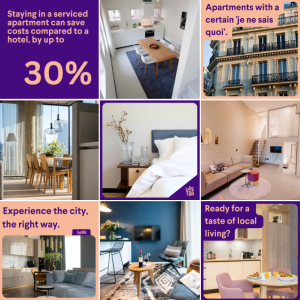
For corporate expats arriving in Europe, this structure reduces friction. There is no need to open utility contracts. No waiting for internet installation. No immediate shopping for essentials. For assignments between one and six months, serviced apartments frequently provide the right balance between comfort and predictability. It's the comfort of a hotel with the convenience of your own kitchen. This is why serviced apartments are often the preferred solution within corporate mobility programs and expat housing strategies lasting a few weeks to several months.
The difference between furnished and serviced apartments
Many corporate employees assume that (fully) furnished and serviced apartments are almost interchangeable. They are not. Here are the most common areas where expectations and reality diverge.
Utilities
In a standard fully furnished apartment, utilities may be separate from rent. Electricity and heating contracts can require local paperwork and deposits. In a serviced apartment, utilities are usually included in one predictable monthly amount. No hassle setting up and ending contracts.
Internet
High-speed internet is essential for most corporate assignments. In fully furnished rentals, it may not be active yet. Serviced apartments typically provide working internet from the day you arrive. You also don't have to worry about closing the contract again once you leave.
Household essentials
Fully furnished does not always mean fully equipped. Bedding, towels, and cookware may not be included. Serviced apartments are structured to cover those details. You are of course free to buy your own add-ons.
Deposit structures
Private landlords may request one to three months’ rent as a deposit. Serviced apartments are built around short and mid-term corporate stays, with clearer contract structures. You usually pay per night, like a hotel. And if your assignment is prolonged unexpectedly, you can often prolong your stay just as easily.
Why serviced apartments often fit corporate mobility better
For corporate assignments, housing is not only about space. It is about timing, predictability, and administrative simplicity. Hotels are convenient but costly for longer stays. Think of added costs like restaurants and laundry services. Unfurnished and partly furnished rentals require too much setup. Fully furnished apartments reduce some of that burden but still leave administrative tasks. Serviced apartments combine residential space with practical readiness. For assignments between one month and one year, they often offer the most balanced solution. Employees can focus on their work instead of managing household logistics.
For longer stays, fully furnished housing may also be considered, especially if the employee relocates with family and wants a more residential feel. The right choice depends on duration, budget, and the level of support required.
How YOSAA supports expat housing across Europe
Standards for furnished apartments Europe vary from one city to another. For companies arranging expat housing, that variation can create uncertainty.
YOSAA focuses exclusively on serviced apartments for corporate stays across Europe. As Your Serviced Apartment Agency, the emphasis is on ready-to-live accommodation where utilities, internet, and practical essentials are already arranged. The goal is not simply to provide furniture, but to ensure operational readiness from the moment the expat arrives.
For corporate mobility teams managing temporary housing in Europe, this approach reduces administrative work and avoids the common gaps associated with traditional fully furnished rentals. Instead of coordinating multiple contracts, companies work with one clear structure designed around business stays in Europe.
Frequently asked questions about furnished apartments Europe
What is the difference between fully furnished and serviced apartment?
Fully furnished usually refers to furniture and appliances. A serviced apartment includes those items plus utilities, internet, and additional services.
Are serviced apartments more expensive?
The monthly rate may be higher than a standard rental, but the price often includes utilities and services, which simplifies budgeting.
Can I register my address in a serviced apartment?
In many cases, yes, but local regulations differ. Always confirm before signing.